AI is reshaping one of software’s quietest but most important business models: developer education.
Tailwind Labs’ sale to Shopify drew attention partly because Tailwind CSS had become so widely embedded in modern web development. Adam Wathan said around the time of the acquisition that the framework was being installed more than 110 million times a week and was used by companies including OpenAI, X, Cloudflare, Reddit and Shopify. On the surface, that looked like a success story for a tool that had become near-ubiquitous.
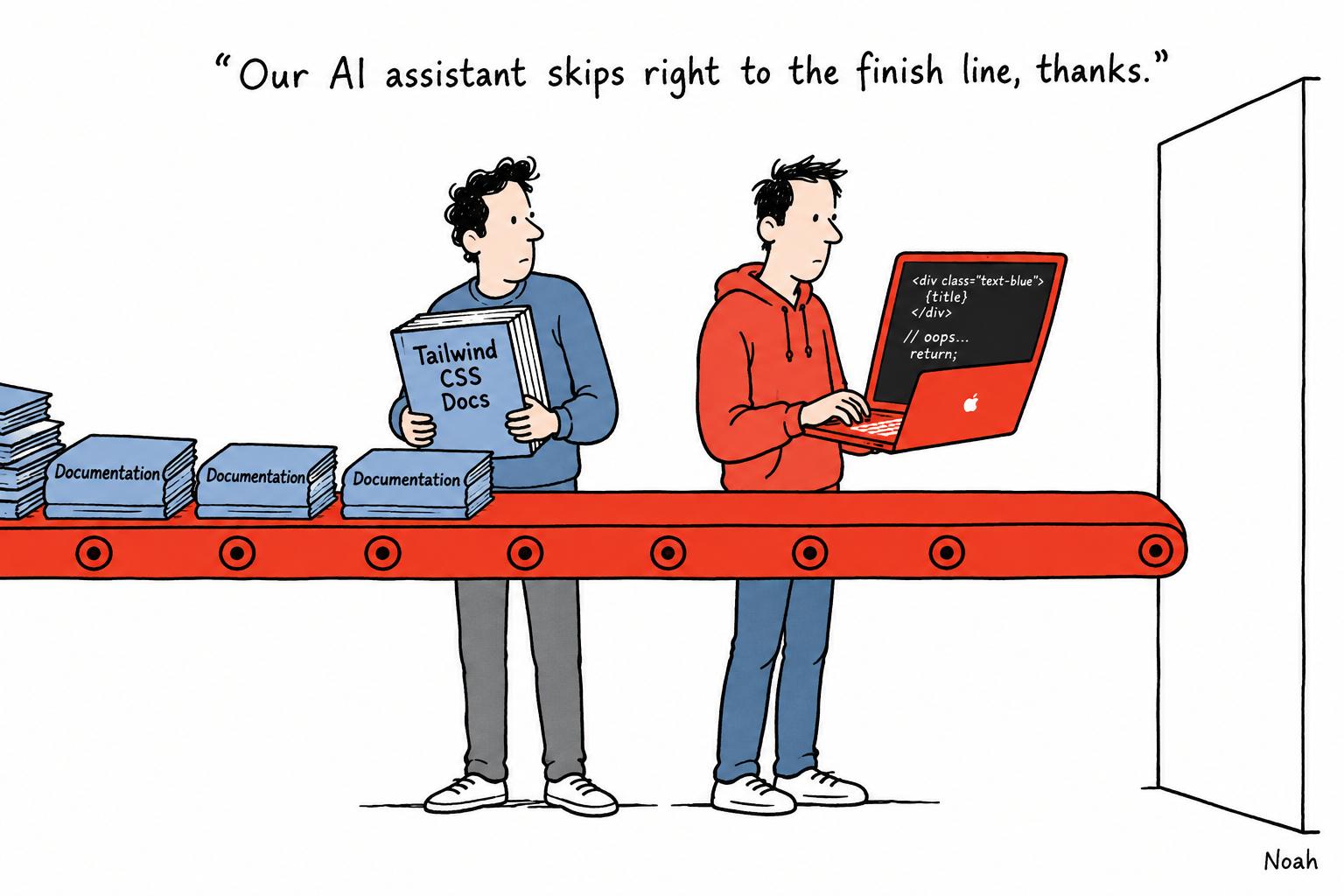
Yet the more revealing story was what happened before the deal. Wathan has said Tailwind’s documentation traffic had fallen by roughly 40% from early 2023 even as the framework’s usage kept growing, while revenue slumped sharply. The change points to a broader disruption: the old path from developer curiosity to product discovery is being broken by AI coding assistants.
For years, the logic of the business was simple. A developer would search for help with a problem, land on Tailwind’s documentation, learn the relevant utility class, and perhaps notice a paid product, template or component suite along the way. That same pattern helped many developer-focused companies turn education into acquisition. Search traffic was not just a support channel; it was a sales funnel.
AI tools have started to cut through that funnel. Instead of opening documentation and hunting for the right answer, developers can now ask Cursor, Claude Code or similar assistants to generate the component directly. The model often already understands Tailwind well enough to produce working code, and if it does not, it can retrieve the documentation itself. The result is fewer human visits to the website that once sat at the centre of the learning process.
The pattern is not unique to Tailwind. It has been visible for some time in the wider developer-education economy, where companies spent heavily on tutorials, walkthroughs, sample applications and documentation because those assets converted later into customers. For years, that investment made commercial sense. A detailed article about building something with Next.js, for instance, could bring a developer back months later when they were solving a related problem in production.
That model is now under pressure as search itself changes. Google’s AI Overviews have been cited as reducing click-through rates to the first organic result, weakening a system that depended on developers arriving at a company’s own site after asking a question. Once the answer is supplied directly in the search results, the chance to build familiarity with the brand, product and ecosystem shrinks.
Chris Oliver’s GoRails offers a similar example in the Rails world. The site became one of the best-known Rails learning resources on the internet, with years of screencasts, tutorials and practical guides. It later expanded into products such as Jumpstart and the Rails hosting platform Hatchbox, with education helping to subsidise the rest of the business.
That balance has shifted. Oliver has said AI has been hard on education businesses and that GoRails is no exception. He has also said the company expects fewer new customers in 2026 than it saw in its first year, prompting him and Collin Jilbert to focus more of their attention on Hatchbox. The irony is striking: the same AI tools that have weakened the education side are also helping the team work faster, research unfamiliar systems, refactor applications and prototype features. The difference is that those tools now allow developers to bypass the tutorials entirely and get straight to a fix inside their own codebase.
That change alters how developers learn as well as how companies sell. The traditional model involved building a series of mental steps: search, read, follow, adapt, remember. Increasingly, the workflow is more like: build, ask, inspect, continue. Developers still consult documentation, but often only after a model produces something questionable or needs verification. The educational journey is becoming shorter, more fragmented and more dependent on AI as a first pass.
This is one reason documentation is being redesigned for both people and machines. Modern developer sites increasingly offer options such as "Copy page", "View as Markdown", "Ask AI" and integrations with MCP. Vercel’s documentation, for example, prominently exposes AI-oriented interactions alongside the usual guides. GitBook has gone further by generating Markdown versions of pages, producing llms.txt and llms-full.txt files, and supporting documentation access through MCP. The message is clear: documentation is no longer only for a human reader skimming a browser tab. It is also for a model parsing context.
The llms.txt proposal, introduced by Jeremy Howard in 2024, captures that shift neatly. It is not yet a universal web standard, and model providers have not all formally committed to using it. But the fact that documentation companies and developer platforms have moved quickly to adopt it shows how urgently they believe the ecosystem is changing. After decades spent optimising for human readers and search engines, websites are beginning to publish a second layer for AI systems.
That may sound technical, but it reflects a deeper cultural change in software development. The point is no longer simply to write better documentation. It is to write documentation that can be consumed, summarised and applied by tools acting on behalf of the developer.
None of this means developers should abandon AI and return to a pre-LLM workflow. That would be as unrealistic as refusing to use search in order to preserve the discipline of reading books. What matters is how deliberately the tools are used. When the goal is to ship, AI can remove friction with extraordinary efficiency. When the goal is to understand, the developer may need to slow down, read the primary source, ask the model to explain its reasoning, or even build part of the thing manually to retain the underlying skill.
That distinction may become increasingly important. AI appears set to become one of the most powerful teaching aids software has ever had: an always-available tutor that knows the codebase, can field unlimited questions and can generate tailored exercises on demand. Yet the default behaviour of most tools remains execution, not education. They solve the problem before they necessarily teach the person.
That is the tension running through Tailwind’s story and the wider developer-education industry. AI is making developers faster, but it is also stripping away some of the commercial value from the learning content that once surrounded them. The companies most exposed are those whose business depended on being the place developers went to learn before they built. In the AI era, the question is whether that learning still happens often enough for the old model to survive.
Source: Noah Wire Services