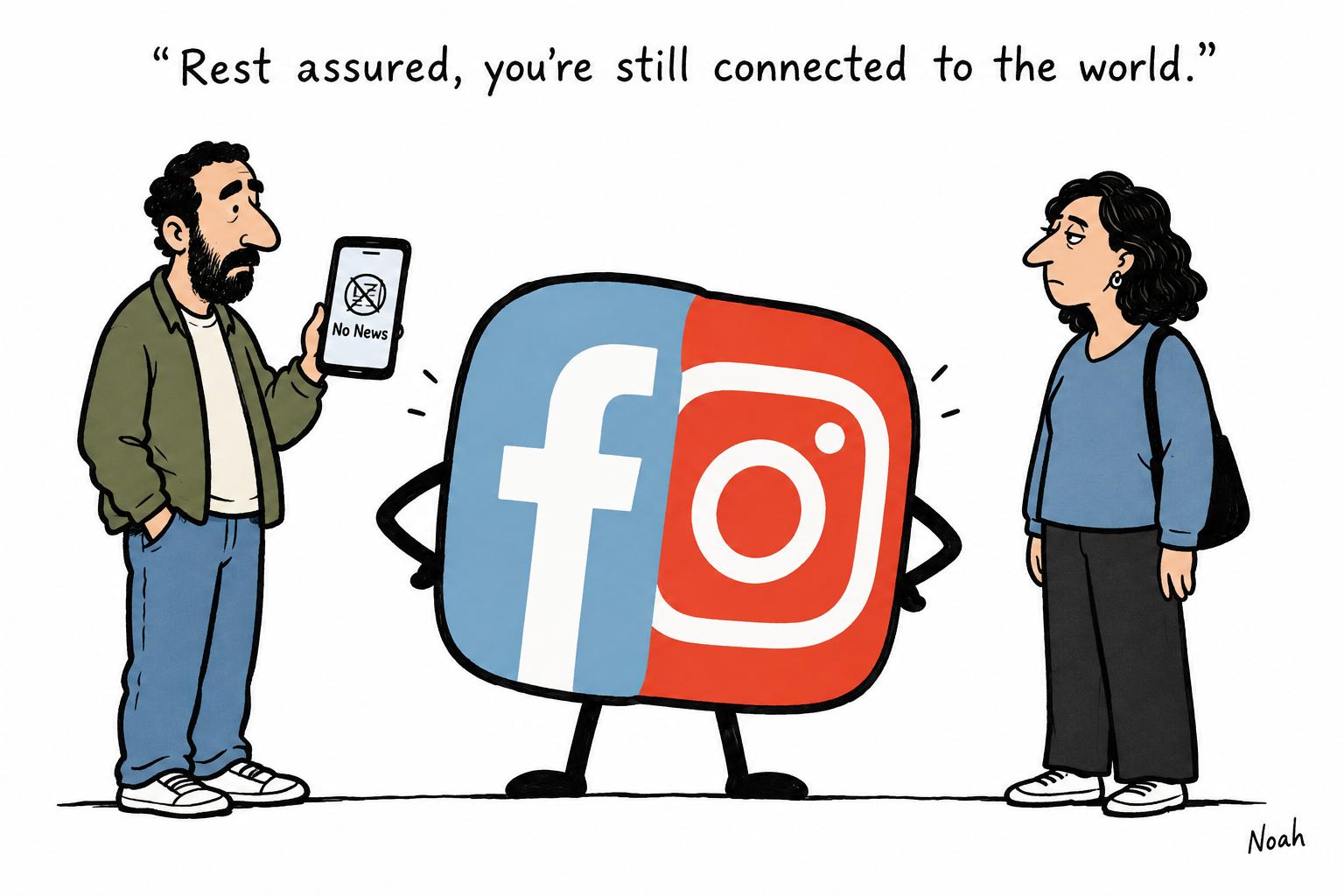
When Meta stopped news from appearing on Facebook and Instagram in Canada, the consequences reached far beyond domestic publishers. For people in the country’s diaspora communities, the change severed an everyday link to events unfolding thousands of miles away, cutting off a familiar route through which news from home once arrived almost casually, in the middle of an ordinary scroll.
That reality is personal for the author, who moved from Lebanon to Canada and found that the reporting she had long relied on no longer surfaced in her feeds. Where she once encountered stories from Lebanese outlets such as Megaphone alongside other regular updates, she began seeing notices saying that people in Canada could not view the material. What had looked at first like distraction or overwork turned out to be something more structural: the information had not gone missing, but the pathway through which it reached her had.
Canada’s Online News Act, introduced in 2023, was designed to address the imbalance between large digital platforms and news organisations, and to help support Canadian journalism. Meta responded by making news unavailable to users in Canada on Facebook and Instagram rather than paying under the new regime. That decision affected far more than Canadian titles. Because the block applied to news content accessed in Canada, international publishers disappeared as well, meaning that a Lebanese reader in Montreal lost access to Beirut-based reporting in the same sweep that removed domestic outlets.
Critics warned from the outset that Meta’s response could weaken journalism and deepen misinformation by reducing the visibility of reliable reporting on the platforms where many people now encounter news. Canadian publishers and broadcasters later urged the country’s competition regulator to step in, arguing that the blackout threatened the viability of local journalism and narrowed public access to trusted information sources.
The implications have been especially stark during moments of crisis. During Canada’s severe wildfire season, the absence of news on Facebook and Instagram made it harder for many users to obtain timely updates, underlining how a policy framed around bargaining power and platform compensation can spill into public safety. What may look like a dispute over media economics can, in practice, alter how people learn about emergencies, how they verify rumours, and how quickly they understand whether a threat is close.
For diaspora communities, the issue is sharper still. Someone can live in Montreal while following politics in Ottawa, worrying about relatives in southern Lebanon, and keeping one eye on reporters in Beirut. In such a life, the boundary drawn by regulation does not line up neatly with the boundaries of identity, family or concern. The law may have been aimed at Canadian journalism, but the information ecosystem it disrupted was always more international, and more intimate, than that.
Other routes to news still exist. Websites, messaging apps and alternative platforms have not disappeared. Yet discovery is not the same as access. A search engine helps only once a reader already knows what to look for; a social feed often tells them that something has happened before they have the words to seek it out. For someone trying to keep track of bombardments, strikes or worsening danger, that distinction matters.
The result is a quieter kind of loss. Lebanese news has not vanished from the internet, but it has become harder to stumble upon from inside Canada. For readers whose first warning system remains a family group chat, the absence of familiar reporting means waiting for messages to pile up before beginning the hunt for answers. In that sense, the debate over Canada’s news law is not only about the economics of journalism, but about who gets to stay connected when the world outside the border is the world that matters most.
Source: Noah Wire Services